

Where To Buy Excavators In Need Of Repair
Introduction to the Excavators Buying Process
Table of Contents
- Introduction
- Trends
- Types
- Specs
- Attachments
- Choosing a Dealer
Introduction
Today, excavators are state-of-the art, using hydraulic power with smaller turning radiuses for tight spaces and intuitive joystick commands. Industries such as structure, utility, public works, mining, demolition, forestry, and landscaping employ them every day to dig the trenches, holes and foundations.
The components of an excavator include:
[table]
Component, Description
Cab, This is where the operator sits and controls the machine through pedals and joysticks.
House, "The house contains the engine, oil and fuel cylinders. It is continued to the undercarriage with a cylindrical casket to enable 360 degree rotation."
Engine, The engine (typically diesel considering of the amount of power needed) sits in the firm and powers not simply movement of the auto but as well the hydraulics used to move the smash and attachments.
Undercarriage, The undercarriage has the gears and motor that facilitates movement of the auto over the ground.
Boom, This is the extension that connects to the bucket and other attachments.
Stick, "The stick connects the blast and the undercarriage, extending or retracting depended on the distance necessary to operate the boom and dig"
[/tabular array]
Choosing the right excavator depends on many factors. Size, controls, and jobsite locations rank high on the list of things to consider.
Size
The size of an excavator will determine your earthworks depth and dig power. The industry refers to excavators in unlike size classes:
[table]
Operating Size, Terminology
0 - half dozen Metric Tons, "Micro, Compact"
6 - 25 Metric Tons, "Mini, Construction Grade"
25 - xl Metric Tons, "Mini, Construction Grade"
xl - 90 Metric Tons, "Big, Production Course"
[/table]
You want to purchase an excavator that will meet your job requirements – and nothing more. If you purchase one that provides a deeper depth and stronger power than you actually demand, you could be wasting coin on actress costs for fuel and perchance transport in add-on to the extra expenditure on the machine itself. Really think nearly the size that makes the most sense for your company now and the foreseeable future.
Controls
There are two main types of excavator controls. One is specified by the Society of Automotive Engineers (SAE), and the other is by the International Organisation for Standardization (ISO).
The two controls are very similar with the biggest divergence being that the controls for the nail arm and dipper arm are reversed. SAE controls are the preferred method in the U.Southward. Information technology's of import to know the difference, especially if you are considering buying a used excavator.
Jobsite locations
Where you are going to apply the machine is a critical consideration. Tight spaces require smaller machines, for instance; however, you want to await into a car that is pocket-sized but however provides the power yous demand.
In addition, evaluate how deep yous dig and the type of breakout strength you will need to get through dissimilar materials. Differences in soil types can dictate what ability you demand, how deep you lot will go and what accessories you need to break through, remove or cultivate the finished product.
Cost
When it comes to excavators, i of the decisions y'all'll accept to brand is used or new. Depending on what y'all choose, the prices will vary. Prices range from $100,000 for a mini-excavator to $500,000 for a large excavator.
You also have the choice to rent an excavator on a task-by-job basis. If you lot are not going to use the excavator for every job, renting as needed may exist the most cost-efficient option. Most rental companies even offering delivery as well. You can rent an excavator for $two,000 to $10,000 a month, depending on the size and blazon of excavator.
Leasing an excavator allows you to get the blazon of excavator you need for a job, at a more affordable cost and for a longer period of time. While rental prices are higher for the aforementioned time period, leasing holds yous responsible for maintenance and transportation costs.
This purchasing guide volition hash out the trends, types, and excavator specifications that will help you choose the best excavator for your job. It volition likewise provide information about various attachments available and advise questions you should ask when interviewing dealers.
Trends
For the last fifty years, improvements in excavator technology focused on refining move (cable to hydraulic functioning), increasing power (engines) and reducing the turn radius (hanging counterweights to null tail turn). Today, trends are focused on improving operation for both the machine and operator, in addition to reducing emissions. The following trends are of import to note as they may influence your purchasing conclusion.
Controls 
In recent years, there take been major updates to excavator joysticks to meliorate the ergonomics for operators. Most of the innovations have focused on making the operator more than comfy and productive while assuasive for faster working speeds. The benefits extend into college period rates, more effective use of the engine ability, better fuel efficiency, and minimizing delays due to engine stalling or overloading.
Operating an excavator used to exist a complicated configuration of levers and pedals, requiring both hands and anxiety. This led to operator fatigue, injury, errors, and ineffective overall apply of the machinery. With the joysticks, all controls are on 2 levers. The left hand controls the swing and extension of the stick while the correct controls the saucepan and boom. Joystick also use roller pads for the thumb too equally push buttons for functions.
Excavator controls have a direct bear on on the productivity of your employees. Like shooting fish in a barrel, intuitive controls placed in an optimal position for comfort results in longer operation times – increasing overall productivity.
Ergonomics
In addition to the joystick feature, manufacturers are trying to create healthier seats for excavators:
- Armrests are adjustable and so that operators can rest their forearms
- Seat height is adjustable
- Seatbacks accept adaptable lumbar support for the back and tilt options to provide a fully-ingrained sitting experience for long operating periods
Interior features are improving too. Cab interiors have evolved from plastic and metal to an environment more like the within of a auto. Operators at present accept climate control, heated seats, remote beginning, and padded seats.
Fifty-fifty access to the cab has gotten easier with wider ladders, recessed steps, and platforms to give the operator room to open the door and climb in. These ergonomic improvements make information technology easier for an employee to exercise their job which results in a college quality of piece of work.
Tier Iv engines and clean diesel fuel technology
The Ecology Protection Agency (EPA) set engine requirements to reduce emissions for new and not-route diesel engines starting in 2011. In 2014, Tier IV standards addressed nitrogen oxide emissions besides. Equally a result, companies have had to purchase new equipment that meets these Tier IV emission standards.
 Make clean diesel applied science is a iii-part organization that combines the use of cleaner diesel fuel in advanced engines with effective emissions control engineering science. The purpose is to reduce the carbon footprint but information technology also promotes ameliorate fuel efficiency. Make clean diesel contains 97% less sulfur than previous versions and is now the standard for all diesel engines. The advanced engines provide more power for less fuel usage. To adjust for the changes in fuel and engines, emissions control engineering also advanced to further reduce emissions.
In a recent heavy equipment buying trends study, excavators saw the highest shift in buyers buying new equipment versus used as a effect of this requirement. While compliance is on the manufacturer, construction companies accept discovered their clients are also demanding that their contractors comply, especially in the regime sector. Not having compliant equipment tin touch your ability to bid and win new work.
Back to height
Specifications
Before settling on an excavator model, information technology's imperative that you lot compare specifications. Specs will aid you make up one's mind if the model you want can really meet the job you need it for.
Dig depth
Maximum dig depth is how far down the car will power the boom and saucepan; essentially, how deep a pigsty yous can dig or remove materials. A skilful tip is to summate the range of depth from previous jobs.
- Identify the lowest and deepest depths
- Figure out how often yous dig that deep
Gathering this information will preclude you from spending extra money on an excavator with excess depth. Dig depth impacts price considering of the engine power and counterweight necessary to achieve information technology. For example, within crawler excavators, dig depth tin can range from 6 anxiety to 25 feet, resulting in every pes of added depth equaling an eight% increase in corresponding toll.
Dump height/bucket capacity 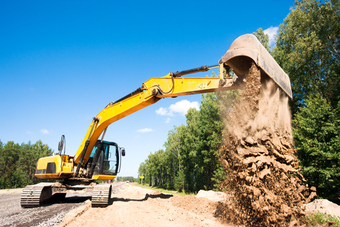
Dump height is important, specially if you are going to be placing exhumed materials on a truck to exist hauled away. You demand to be sure the boom and bucket will clear the sides of the dump truck. If you are moving material effectually a jobsite, dump superlative is not as much a critical factor.
For instance, compact excavators have a maximum dump height of 13 feet while crawler excavators take heights that exceed 30 feet.
Bucket chapters impacts how much material tin be removed at whatever ane time. For large digging projects, time is disquisitional. However, for more precise projects, a smaller saucepan capacity allows for consequent operation. Bucket capacity does not have a big impact on price equally dissimilar types and sizes of buckets are available equally accessories.
Weight
An excavator's weight has no bear upon on toll. However, weight does have two areas of consideration.
- Surface damage: weight of the machine can be a factor if surface damage is a concern. For instance, if near of your jobs are landscaping, minimizing damage is probably a priority. Therefore, the less the excavator weight, the less impairment there is likely to exist. So fifty-fifty if a task takes longer or requires more trips, a smaller machine is the better value for yous.
- Operating weight: non to be confused with equipment weight, operating weight is another way to describe the counterweight. For instance, an excavator with an operating weight range of 4 tons ways that the load at the stop of the nail cannot exceed 4 tons.
The information plate of the excavator will tell yous the minimum and maximum operating weight. It'south important to note that the maximum operating weight is a full bucket load with the boom and stick at its furthest extension.
Size
Jobsite location is a crucial factor to consider equally y'all think about the size of excavator you want to purchase. Important questions to ask include:
- Do you work in tight spaces with express turning radius?
- Do you work in wide open spaces?
- Can you lot transport the excavator?
- What terrain will you be working on?
Mini excavators are a great option for tight spaces and jobs that do non crave a lot of power. They are versatile and easy to transport every bit well. Larger excavators require larger trailers with a higher weight tolerance.
Engine power
Engine power goes paw in hand with maximum dig depth, weight and size. All work in tandem to go the task done right. As you compare machines with similar specifications, it's important to also think about engine type. The type of engine you get with volition ultimately touch on fuel and maintenance costs.
[tabular array]
Compact, Crawler, Heavy
Under 20 tons, 20-40 tons, To a higher place twoscore tons
95 - 120 HP, 150 - 275 HP, 367 - 532 HP
[/table]
As you tin can see, within each category of excavator, in that location horsepower varies. By selecting an excavator that meets the job requirements with a minimum amount of horsepower, you save money in the long term while reducing your initial expenditure. It can be easy to get sucked into "just in case" scenarios requiring greater capability. But unless those scenarios are probable, going bigger with more power could exercise more harm than skilful.
Dorsum to top
Choosing a Quality Dealer
It'due south important to not only choose the right excavator for your job, simply to also choose a dealer who meets your needs. The dealer you choose should accept a wealth of knowledge on the equipment they sell. Past request them the following questions, y'all'll be able to come to a solution that's right all effectually.
 Training
Excavators are a large and potentially unsafe piece of equipment. While it'southward not required to have a specialty license or certification, you're putting your business at risk if operators don't have them. As a result, ask your dealer most training options for your operators; whether operators can go to a facility to train or your dealer tin can provide a teaching course.
Maintenance
Ask the dealer about routine maintenance requirements: can maintenance exist performed in the field, at your shop or at the dealer'due south location? You will want to make sure that you practice not take any activity that could mayhap void a warranty.
Excavators will require routine service. The intervals are determined past the hour meter reading. Maintenance tasks include items such equally:
[table]
Service Interval, Description, Service Activity
ten hours, "Fluids (hydraulic, engine, radiator)", Check and add together fluids
50 hours, Rails Tension, Check and adjust
250 hours, Battery, Cheque and clean
500 hours, Engine Oil and Filter, Change
"1,000 hours", Swing Reduction Gear Case, Change
"2,000 hours", Radiator Coolant, Change
"5,000 hours", Hydraulic Oil, Change
[/table]
The dealer should provide you with a complete listing of such actions when you make a purchase, specific to the manufacturer and model.
Back up and warranties
When problems occur, they are more likely to happen at a job site than anywhere else. Does the dealer offer on-site service if excavators need it immediately? Do they have parts on mitt for that model? Reanimation is lost coin.
A traditional, new excavator warranty policy is total coverage for 3 years or 3,000 hours, whichever comes first. It may vary by manufacturer. Warranties on used excavators are on the powertrain and hydraulics. The industry average period is 3 years or 5,000 hours.

Source: https://www.purchasing.com/construction-equipment/excavators/purchasing-guide/index.html
Posted by: matsonmoseect.blogspot.com
0 Response to "Where To Buy Excavators In Need Of Repair"
Post a Comment